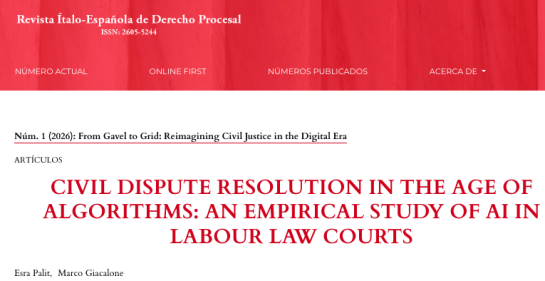

The DIKE Research Group is pleased to announce the recent publication of the article “Civil Dispute Resolution in the Age of Algorithms: An Empirical Study of AI in Labour Law Courts”, co-authored by Esra Palit and Prof. Marco Giacalone, in the esteemed Revista Ítalo-Española de Derecho Procesal (Italo-Spanish Journal of Procedural Law), featured in the journal’s Special Issue No. 1 (2026): From Gavel to Grid: Reimagining Civil Justice in the Digital Era.
Overview of the Article
Can digitalisation and artificial intelligence genuinely improve access to justice in labour law disputes, without compromising fundamental rights and the rule of law?
That is the central question addressed in the article, which combines doctrinal analysis with original empirical research conducted through semi-structured interviews and focus groups with judges, court staff, lawyers, mediators, and policymakers across six EU Member States: Belgium, Croatia, Czechia, Estonia, Italy, and Lithuania.
While access to justice is framed as a fundamental right, the research question is situated within the socio-legal fourth-wave theory of access to justice, understood as a transition towards technology-driven dispute resolution. The article then reviews the EU’s judicial digitalisation strategy, describing the shift from soft-law AI instruments to the binding AI Act, which classifies justice-related AI as high-risk and requires human oversight. Yet that requirement presupposes mature infrastructure, coherent governance, and well-trained professionals.
The findings show that this requirement depends on unevenly developed digital infrastructure, coherent governance, and sufficient professional training. Digital maturity varies significantly across the EU. Notably, even in the most digitally mature systems, respondents did not observe a corresponding improvement in case duration, as technology alone does not guarantee efficiency gains.
Across all six countries, justice professionals were generally open to administrative AI, including document handling, pseudonymisation, and translation, as well as cognitive-support AI, such as legal research, drafting, and summarisation, provided that outputs remain subject to professional verification. Attitudes shifted, however, toward predictive AI capable of influencing adjudicative outcomes. This concern was especially visible among judges, who pointed to risks of automation bias, reduced discretion, standardised reasoning, and possible disadvantages for weaker parties in fact-sensitive labour disputes.
The findings therefore suggest that human oversight is not merely an individual duty but a structural capacity problem. Without tailored training and institutional support, the AI Act’s safeguards risk becoming formal rather than meaningful, with digitally confident professionals acting as de facto gatekeepers while others are sidelined.
The fourth wave of access to justice therefore appears to require sustained institutional investment in both people and procedures. The article argues that EU and national policymakers should shift attention from regulatory ambition to implementation conditions, investing as much in training, organisational design, and evaluation mechanisms as in the technology itself.
The full article is available open access: Palit, E., & Giacalone, M. (2026). Civil Dispute Resolution in the Age of Algorithms: An Empirical Study of AI in Labour Law Courts. Revista Ítalo-Española de Derecho Procesal, 285–305. DOI: https://doi.org/10.37417/rivitsproc/3341
This research was conducted as part of the IDEA project, co-funded by the European Union under the JUST-2023-JACC-EJUSTICE programme, grant agreement no. 101160528. Views expressed are those of the authors and do not necessarily reflect those of the European Union or the European Commission.